
When talking about AI tools for car dealerships in 2026, automotive retail is moving toward faster, more connected customer experiences. Dealerships can now use AI to respond to leads, answer customer questions, manage follow-ups, analyze customer information and improve vehicle marketing. The goal is not simply to add another technology to the dealership, but to reduce repetitive work and help sales teams respond when customers are ready to buy.
A modern dealership manages hundreds of customer interactions across phone calls, websites, messaging platforms, social media and showroom visits. Sales teams also have to track inventory, test drives, financing inquiries, service appointments and follow-ups. AI can help connect these activities and give dealership teams more time to focus on customers and actual sales conversations.
Advantages of AI Tools for Car Dealerships
Car dealerships can lose valuable opportunities when leads are not answered quickly or follow-ups are missed. AI can assist with these repetitive activities while keeping sales representatives involved when a customer needs personal attention.
- Faster responses to vehicle inquiries
- Automated lead follow-ups
- Better customer communication
- Improved appointment scheduling
- Easier management of customer information
- More efficient vehicle marketing
- Better sales and service coordination
- Reduced repetitive administrative work
| Dealership Task | How AI Can Help |
|---|---|
| Lead management | Respond, qualify and follow up with prospects |
| Customer inquiries | Answer routine questions 24/7 |
| Vehicle marketing | Create descriptions and digital content |
| Appointment booking | Schedule sales and service appointments |
| CRM management | Organize customer interactions |
| Sales follow-up | Personalize messages and reminders |
| Service | Identify customers due for appointments |
The biggest opportunity is using AI to make sure genuine customer opportunities do not disappear simply because a salesperson was unavailable.
Below are the best AI tools for car dealerships in 2026 & beyond –
1. Impel AI
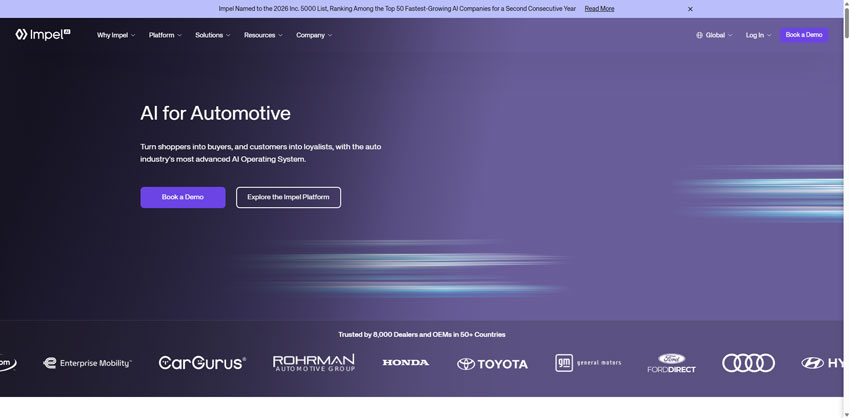
Impel is an automotive-focused AI platform designed around the customer lifecycle. Its tools cover areas such as sales, service, digital merchandising, conversational AI and customer engagement. The platform says it serves more than 8,000 dealers and OEMs across more than 50 countries.
Its AI capabilities can help dealerships respond to leads, answer customer questions and support appointment booking. Impel has also expanded its automotive AI offering in 2026, with major manufacturer programs including Hyundai and General Motors. Hyundai Motor America certified Impel’s Chat AI for its dealer marketing program in September 2026, making the technology available to more than 830 Hyundai dealers in the U.S.
For dealerships, this can be useful when shoppers contact the business outside normal working hours. An AI system that understands automotive information can provide more relevant answers than a generic chatbot, while sales staff can step in when a conversation requires human involvement.
Website Link – https://impel.ai/
2. Salesforce Automotive Cloud
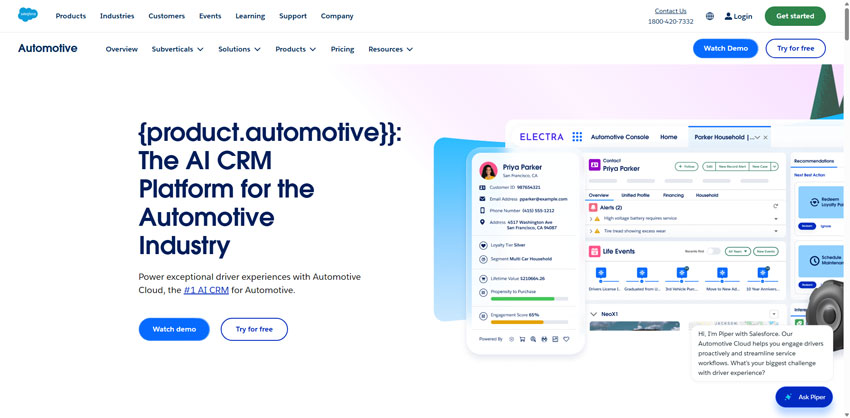
Salesforce Automotive Cloud is an automotive-focused CRM platform designed for manufacturers, retailers and dealerships. It brings customer and vehicle information together and provides tools for sales, service, warranties, claims and customer engagement. Salesforce also integrates AI and automation into the platform to help teams act on customer information.
For a dealership, having a unified customer view can be valuable. Sales representatives can see information related to vehicle interests, previous interactions and service history rather than working from disconnected records.
The platform can also help dealerships create more connected sales and service experiences. AI becomes more useful when it has access to reliable dealership data because recommendations and automated actions can be based on the customer’s actual relationship with the business.
Salesforce Automotive Cloud is particularly relevant to larger dealerships and automotive groups that need a scalable CRM environment rather than a single-purpose AI chatbot.
Website Link – https://www.salesforce.com/in/automotive/cloud/
3. Fullpath
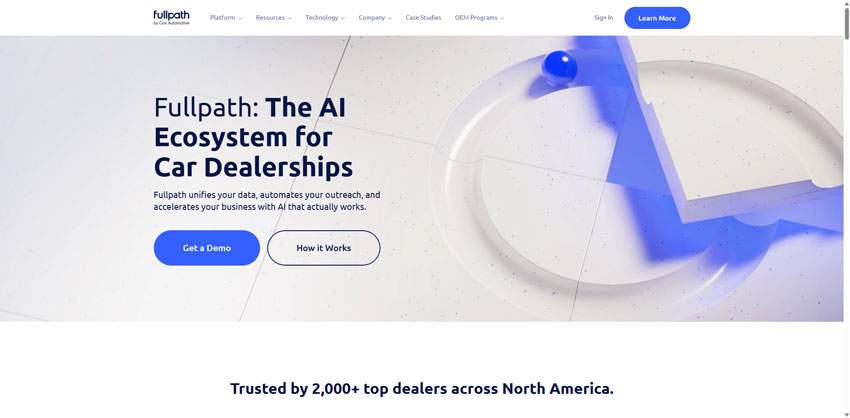
Fullpath provides an automotive-focused Customer Data Platform and AI-powered tools designed for dealerships. Its platform brings together customer information, marketing automation and AI agents to support sales, marketing and service workflows. The company says its platform is used by more than 2,000 dealers.
For car dealerships, customer data is spread across many interactions. A shopper might visit the website, submit a form, speak to a salesperson and return weeks later. A unified data approach can help dealerships understand these interactions and create more relevant follow-ups.
Fullpath’s AI agents are designed to work with dealership data and support customer engagement. This can help dealerships move away from generic follow-up messages and toward communication that reflects the customer’s actual history and interests.
The platform can therefore be useful for dealerships looking to combine CRM, marketing automation and AI rather than managing each activity separately.
Website Link – https://www.fullpath.com/
4. DealersAI
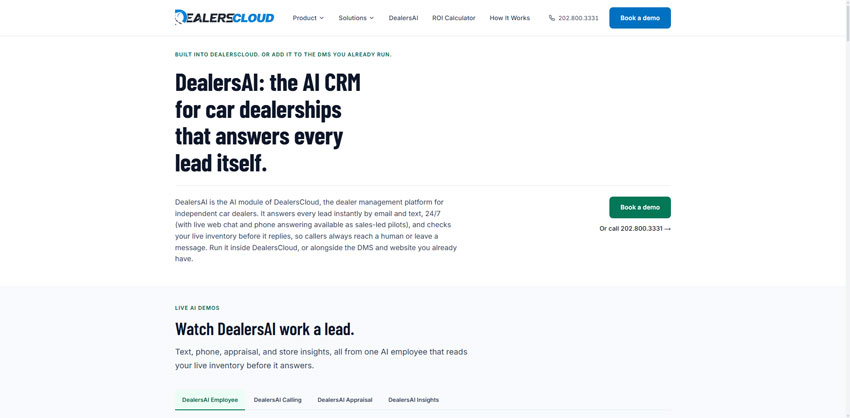
DealersAI is an AI CRM solution from DealersCloud designed specifically for independent car dealers. It can respond to leads through text, email and website chat, answer phone calls, book appointments and work with live vehicle inventory. The company says it can operate alongside an existing DMS, which can be useful for dealers that do not want to replace their current systems.
One practical benefit is its focus on inventory-aware conversations. A customer asking about a particular vehicle needs accurate information about what is actually available. DealersAI says its system reads live inventory before responding, helping avoid generic responses that may not match the dealer’s current stock.
For smaller dealerships, this type of automation can be especially useful because the same team may handle sales, calls, internet leads and walk-in customers. An AI assistant can cover routine conversations while salespeople concentrate on qualified shoppers and showroom activity.
Website Link – https://www.dealerscloud.com/dealersai
5. AutoRaptor
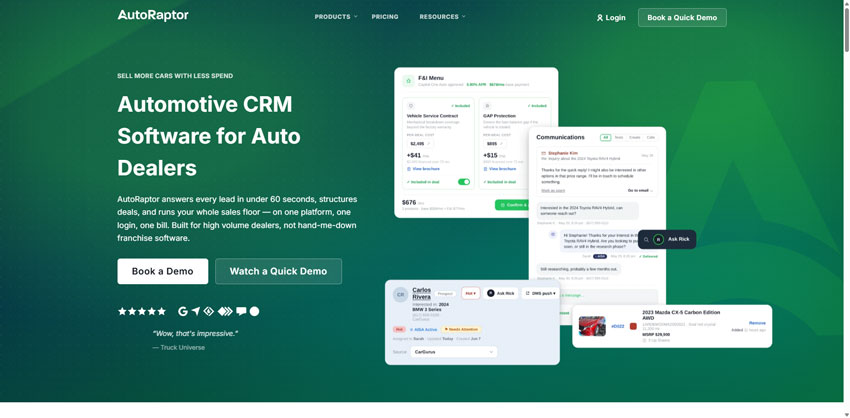
AutoRaptor is an automotive CRM platform that combines lead management, communications, reporting and AI-assisted sales features. Its AI Sales Assistant is designed to respond to inbound leads through channels such as text, email, chat and voice. The platform also provides dealership reporting and sales-management features.
For dealerships, managing leads from different sources can become difficult when every inquiry needs individual attention. A centralized CRM can help sales teams track where each lead came from, what communication has already taken place and what action should happen next.
AutoRaptor also provides reporting capabilities that can help dealerships understand lead sources and sales activity. The combination of lead response and reporting can help managers look beyond the number of inquiries and understand how those opportunities are actually moving through the sales process.
This makes it relevant for dealerships that want AI assistance while keeping lead management and sales reporting inside the same system.
Website Link – https://get.autoraptor.com/
Why Car Dealerships Have to Use AI Tools in 2026
Car dealerships receive customer inquiries at all hours. A potential buyer may submit a website inquiry late at night, send a message during a weekend or call while the sales team is already helping another customer. Delayed responses can make the sales process harder to manage.
AI can help dealerships respond to routine questions, capture lead information and start follow-ups without requiring a salesperson to be available every minute. The purpose is not to remove salespeople from the process, but to make sure salespeople receive better-prepared opportunities.
AI is also becoming useful beyond lead generation. Automotive platforms are applying AI to CRM, service communication, digital merchandising, customer engagement and business workflows. Salesforce, for example, positions Automotive Cloud around unified driver and vehicle information, sales and service interactions, and AI-powered recommendations.
For dealerships, this broader approach matters because the customer relationship does not end after the vehicle sale. Service appointments, warranty information, maintenance and future vehicle purchases all create additional customer touchpoints.
However, dealerships should introduce AI carefully. Customer data, financing information and communication records should be handled according to applicable privacy and security requirements. AI-generated information should also be reviewed when accuracy, pricing, financing or contractual details are involved.
Conclusion
AI tools for car dealerships in 2026 can support many parts of the automotive sales and service journey. From answering leads and booking appointments to managing customer information and improving marketing workflows, AI can reduce repetitive work and help dealership teams respond more consistently.
There is no single AI solution that fits every dealership. A small independent dealer may prioritize lead response and inventory-aware communication, while a large dealer group may need a complete automotive CRM and customer data platform.
The most useful dealership AI strategy is to automate repetitive activities while keeping people responsible for important customer conversations and business decisions.
As automotive retail becomes increasingly digital, dealerships that combine AI with accurate data and strong human service can create a smoother experience for both customers and sales teams. The technology should support the dealership’s people, not replace the relationships that drive automotive business.
FAQ
Q1. What are AI tools for car dealerships?
AI tools for car dealerships are software solutions that help with lead management, customer communication, follow-ups, appointment scheduling, CRM, vehicle marketing, service communication and other dealership workflows.
Q2. How can AI help a car dealership get more leads?
AI can respond to inquiries quickly, qualify prospects, follow up with shoppers and help schedule appointments. It can improve the handling of existing opportunities, but it does not guarantee additional sales.
Q3. Can AI answer customer questions about vehicles?
Yes. Automotive AI platforms can be connected to dealership information and, in some cases, live inventory. Dealerships should ensure the underlying information is accurate before allowing automated systems to communicate with customers.
Q4. Can AI help dealerships with service customers?
Yes. Automotive AI platforms can support service communication, appointment scheduling and customer follow-ups. Some platforms can also use vehicle and service information to identify useful customer touchpoints.
Q5. Will AI replace car salespeople?
AI is primarily being used to automate repetitive communication and administrative tasks. Salespeople remain important for negotiations, product demonstrations, relationship building and complex customer decisions.