
When talking about AI tools for architects in 2026, artificial intelligence is changing how architects explore concepts, visualize buildings, analyze sites and prepare design presentations. AI-powered software can generate architectural visuals, explore alternative layouts and support early-stage planning. These capabilities help architects experiment with ideas faster while keeping design decisions under professional control.
Architecture involves more than creating attractive buildings. Architects must balance client requirements, site conditions, budgets, sustainability, building regulations and structural considerations. Across India and the USA, AI is becoming a useful addition to architectural workflows, from residential projects to commercial developments. The real benefit of AI is helping architects explore more possibilities without compromising design quality or professional responsibility.
Advantages of AI Tools for Architects
Architectural projects often require multiple design revisions before a client approves a concept. AI can help architects explore visual directions, prepare presentations and investigate design alternatives more efficiently.
- Faster architectural concept development
- More design variations during early planning
- Improved architectural visualization
- Easier exploration of materials and finishes
- Support for site analysis and environmental studies
- Faster client presentations and mood boards
- Reduced repetitive design tasks
- Better collaboration during early design stages
| Architectural Task | How AI Can Help |
|---|---|
| Concept design | Generate alternative architectural ideas |
| Rendering | Create visualizations from prompts or sketches |
| Site planning | Explore layouts and environmental factors |
| Building design | Investigate alternative design options |
| Client presentations | Prepare mood boards and concept visuals |
| Documentation | Assist with repetitive drafting workflows |
AI-generated concepts are starting points, not approved construction documents. Architects must independently verify dimensions, accessibility, structural requirements, building codes and other technical details.
Below are the best AI tools for architects in 2026 & beyond –
1. Autodesk Forma
Autodesk Forma is a cloud-based platform for architecture, engineering and construction workflows. Its AI-assisted capabilities support early-stage site planning, building layout exploration and environmental analysis. Architects can investigate factors such as sunlight, wind, noise and embodied carbon while evaluating different design possibilities.
For architects, this can be especially useful before committing to a detailed building model. Exploring site conditions and alternative layouts early can help teams understand potential design trade-offs and discuss options with clients. Autodesk has also introduced workflows connecting Forma with Revit, helping teams carry decisions from early planning into detailed design. <Cite refs={[“turn916988search3″,”turn916988search11”]}/>
Autodesk Forma is particularly useful when architects need to evaluate site conditions and design alternatives before detailed modeling begins. Availability and capabilities depend on the specific product, subscription and region.
Website Link – https://www.autodesk.com/solutions/autodesk-ai/ai-in-architecture-engineering

2. Adobe Firefly
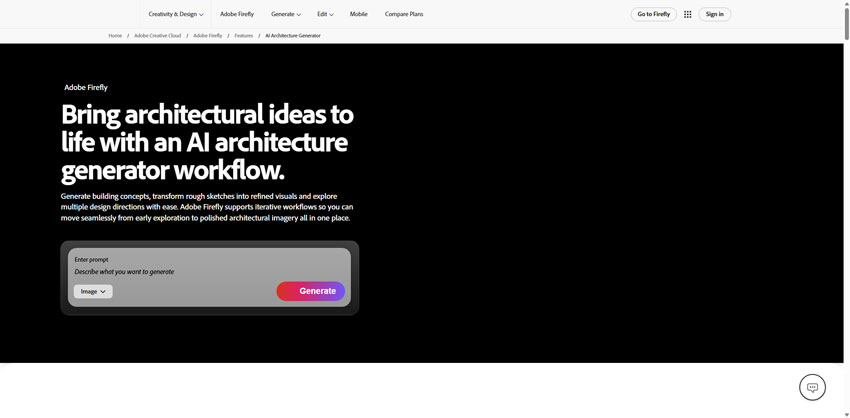
Adobe Firefly is a generative AI tool that can help architects turn written descriptions, sketches and reference images into architectural concept visuals. It supports workflows for exploring building styles, facade ideas, interior concepts, material treatments and presentation imagery.
Architects can use Firefly during early creative discussions when clients have a broad idea but cannot yet visualize the final result. A rough sketch or written prompt can become a visual reference that helps compare styles, colors, lighting and finishes. These images can also support mood boards and preliminary proposals. <Cite refs={[“turn916988search7″,”turn916988search15”]}/>
Firefly is best suited to visual exploration rather than technical modeling. Generated images may change important architectural details, so they should not be treated as accurate representations of buildable plans.
Its main advantage is helping architects communicate and compare creative directions before investing time in detailed modeling.
Website Link – https://www.adobe.com/in/products/firefly/features/ai-architecture-generator.html
3. SketchUp
SketchUp is a 3D modeling platform used for architectural design, interior layouts and conceptual modeling. Its ecosystem includes AI-assisted visualization and design workflows that help architects explore the appearance of a model without rebuilding every visual element manually.
Architects can use SketchUp to develop building forms, room layouts and spatial concepts. AI-assisted rendering workflows can help explore materials, lighting, landscaping and different architectural styles, making it easier to present design alternatives to clients.
The platform is particularly useful when an architect wants to combine familiar 3D modeling with faster visual experimentation. AI can improve the presentation of a design, but the underlying model must still be checked for correct geometry, dimensions and technical feasibility.
Architects should review the specific AI features available in their version and subscription before choosing a workflow.
Website Link – https://www.sketchup.com/

4. TestFit
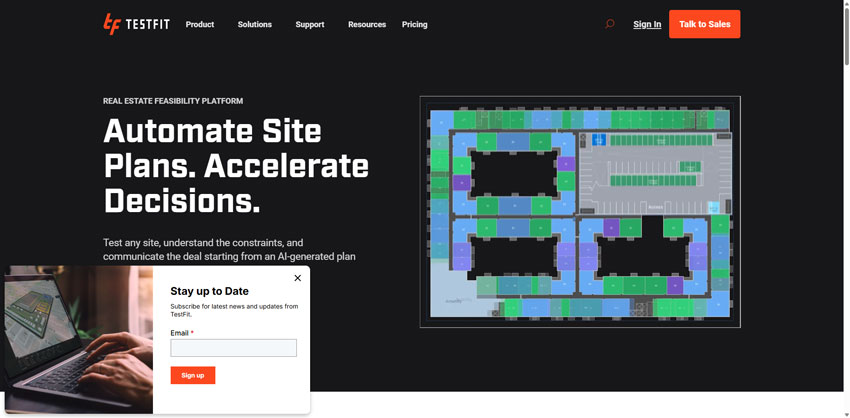
TestFit is a real estate feasibility and site-planning platform designed to help teams evaluate development opportunities. It can generate and compare site layouts based on project requirements and constraints, helping users explore building configurations, parking arrangements and development potential.
For architects working on multifamily housing, commercial projects or other development-focused assignments, early feasibility work can be time-consuming. TestFit helps teams investigate alternatives and understand how different assumptions affect a proposed development before proceeding to detailed design.
This can support conversations with developers and clients about site capacity, project configuration and possible trade-offs. The value of feasibility software is faster option testing, not a guarantee that a proposed layout will receive planning approval or satisfy every building requirement.
Architects should verify outputs against actual site information, local planning rules, accessibility requirements and applicable codes.
Website Link – https://www.testfit.io/
5. Midjourney
Midjourney is an AI image-generation tool that architects can use to explore building concepts, architectural styles, facade treatments and interior atmospheres. By describing a scene through text prompts and reference images, users can generate visual directions for further discussion and refinement.
For example, an architect could explore contemporary residential facades, sustainable-looking materials, landscape integration or alternative interior moods before developing a detailed model. These visuals can help clients communicate preferences that may otherwise be difficult to describe.
Midjourney is especially useful for creative exploration, mood boards and early presentations. However, a generated image may contain inconsistent proportions, impossible structural details or elements that cannot be built as shown.
Use Midjourney to communicate design intent, not as a substitute for CAD, BIM or engineering validation. The architect remains responsible for translating a visual concept into a technically sound design.
Website Link – https://www.midjourney.com/

Why Architects Have to Use AI Tools in 2026
Architects regularly balance creativity with demanding project requirements. They must explore design ideas, respond to revisions, coordinate with clients and consultants, and prepare drawings and presentations. AI can help with some repetitive tasks and make early-stage design exploration faster.
The technology is also moving into more specialized workflows. Autodesk is developing AI-assisted environmental analysis, generative design and connected workflows, while Adobe Firefly supports architectural visualization from prompts and sketches. <Cite refs={[“turn916988search3″,”turn916988search7”]}/>
These tools can help architects explore alternatives earlier, communicate concepts more clearly and spend more time evaluating the design rather than manually producing every preliminary visual.
However, architectural work carries real-world responsibilities. AI does not independently guarantee compliance with building codes, fire safety, accessibility rules, structural engineering requirements or local planning regulations. Architects must verify technical outputs and retain professional oversight at every critical stage.
Conclusion
AI tools for architects in 2026 are becoming useful assistants for concept development, site analysis, architectural visualization and early-stage planning. Autodesk Forma supports site and design exploration, Adobe Firefly and Midjourney help with visual concepts, SketchUp supports 3D modeling workflows, and TestFit helps investigate development feasibility.
The right choice depends on the stage of the project. Architects exploring visual styles may prioritize image-generation tools, while professionals handling site planning or development feasibility may benefit more from specialized design software.
AI should expand an architect’s ability to explore ideas, not replace the technical knowledge and judgment required to create safe, functional buildings.
By combining AI-assisted workflows with professional expertise, architects can improve design exploration, communicate more effectively with clients and make better-informed decisions throughout the design process.
FAQ
Q1. What are AI tools for architects?
AI tools for architects are software applications that assist with concept generation, visualization, site analysis, design exploration, documentation and other architectural workflows.
Q2. What is the best AI tool for architects in 2026?
The best tool depends on the task. Autodesk Forma supports site and early design analysis, Adobe Firefly and Midjourney help generate concept visuals, SketchUp supports 3D modeling, and TestFit helps with development feasibility.
Q3. Can AI generate architectural designs?
Yes. AI can generate concept images, explore design variations and assist with early layout studies. Architects must still develop and verify technically accurate designs.
Q4. Can architects use AI for client presentations?
Yes. Tools such as Adobe Firefly and Midjourney can help create mood boards and concept visuals. The architect should clearly distinguish illustrative AI imagery from verified design drawings.
Q5. Will AI replace architects?
AI can automate or assist with certain tasks, but architectural work still requires creativity, technical expertise, regulatory knowledge, coordination and professional responsibility. AI is best used to support architects rather than replace them.