

When talking about AI tools for lawyers in 2026, law firms are moving from experimenting with artificial intelligence to using it for practical legal work. AI can assist with legal research, document review, drafting, case analysis, matter management and other repetitive tasks. The biggest opportunity is not replacing lawyers, but helping legal professionals spend less time on routine work and more time applying judgment and strategy.
Law firms handle large volumes of case files, contracts, correspondence, legislation and legal research. Reviewing all this information manually can take considerable time. Across India, the USA and other legal markets, firms are increasingly exploring legal-specific AI platforms that combine automation with legal sources and document analysis. For lawyers, the most valuable AI tools are those that improve efficiency without compromising accuracy, confidentiality or professional responsibility.
Advantages of AI Tools for Lawyers
Legal work requires careful attention to detail, but many tasks performed by lawyers and legal teams are repetitive. AI can help summarize documents, organize information, identify relevant issues and prepare first drafts.
- Faster legal research
- Reduced document-review workload
- Faster contract and case analysis
- Assistance with legal drafting
- Better organization of matter information
- Reduced administrative workload
- More time for client service and legal strategy
| Legal Task | How AI Can Help |
|---|---|
| Legal research | Find and summarize relevant authorities |
| Document review | Identify clauses, issues and key information |
| Drafting | Create first drafts for lawyer review |
| Case preparation | Organize facts, timelines and arguments |
| Contract analysis | Compare clauses and identify potential issues |
| Client communication | Prepare drafts and summaries |
| Firm operations | Assist with deadlines and administrative work |
AI should be treated as a legal work assistant, not as an independent source of legal advice or a replacement for professional judgment.
Below are the best AI tools for lawyers in 2026 & beyond –
1. CoCounsel Legal
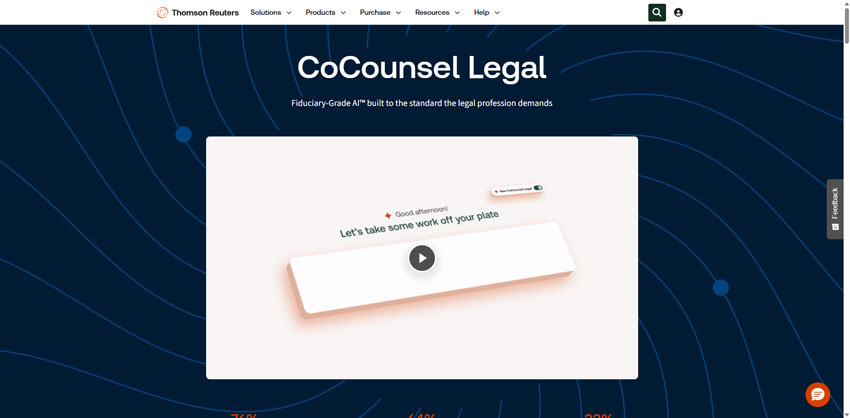
CoCounsel Legal from Thomson Reuters is a legal AI platform designed for research, analysis and drafting. Its 2026 version brings together AI workflows with Westlaw, Practical Law and an organization’s own knowledge. Thomson Reuters says the platform can take a plain-language request and work through research, analysis and drafting while providing linked citations for verification.
For law firms, this can be particularly useful when lawyers need to work through large amounts of legal information. CoCounsel can assist with document review, research questions, drafting and matter-specific analysis, potentially reducing the amount of manual preparation required before a lawyer makes a decision.
The platform is also designed around verification. Its sources can be inspected rather than treating an AI response as an unexplained answer. For high-stakes legal work, the ability to trace an AI-generated conclusion back to legal authority is an important part of responsible adoption.
Website Link – https://legal.thomsonreuters.com/en/products/cocounsel-legal
2. Lexis+ with Protégé
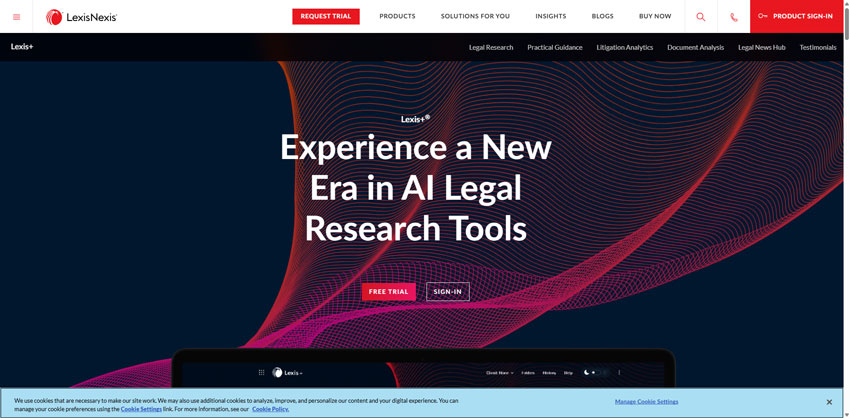
Lexis+ with Protégé is LexisNexis’s legal AI platform for research, drafting and analysis. Formerly known as Lexis+ AI, the platform combines the Protégé AI assistant with LexisNexis legal content and specialized legal workflows. Its 2026 capabilities include agentic drafting, citation verification and tools for complex legal work.
For lawyers, the platform can help with legal research, drafting contracts and litigation documents, analyzing legal questions and working with authoritative legal sources. It is particularly relevant to firms that already rely on LexisNexis research resources.
The ability to connect AI with established legal research content is important because general-purpose AI does not automatically know which legal authority is current or controlling. Lawyers should still verify important authorities, interpretations and citations before relying on them in professional work.
Website Link – https://www.lexisnexis.com/en-in/products/lexis-plus
3. Clio Work
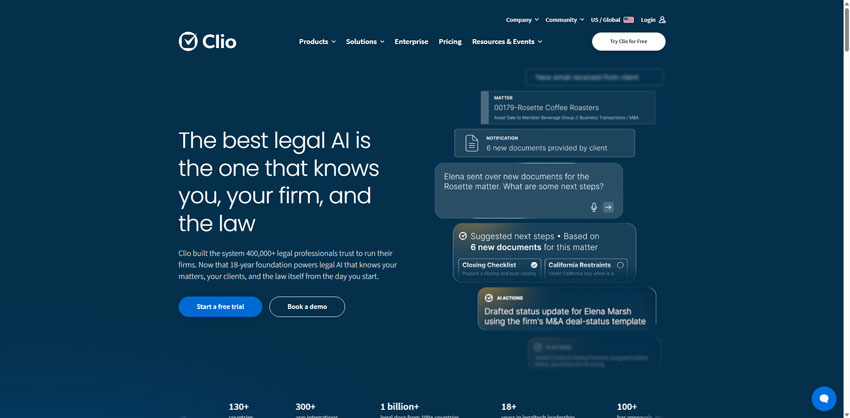
Clio Work is an AI-powered legal workspace designed to help lawyers work with matter information, legal research, case strategy and drafting. Clio describes the product as matter-aware AI that can analyze case materials, surface facts and risks, provide cited research and assist with drafting.
For small and mid-sized law firms, this type of tool can be valuable because legal work often involves switching between case files, documents, research platforms and drafting software. Bringing more of that context together can reduce interruptions and repetitive searching.
Clio also emphasizes security and says customer data is not used to train its AI models. For law firms, data handling should always be reviewed carefully because client confidentiality and privilege are fundamental considerations when introducing AI into legal workflows.
Clio’s broader platform also includes AI capabilities for administrative activities such as deadlines, client messages and billing, making it relevant beyond substantive legal research.
Website Link – https://www.clio.com/
4. Vincent by Clio
Vincent by Clio is an AI-powered legal research and document-analysis tool designed to help lawyers investigate legal issues, review documents and develop arguments. It uses legal authority to ground its answers and was expanded to mobile devices in 2026, allowing lawyers to access its capabilities through iPhone and Android applications.
Vincent can be useful when a lawyer needs to understand a large document or investigate a particular legal question without manually searching through every page. It can help surface relevant information and provide cited answers that lawyers can then examine more closely.
This can be particularly useful during active matters when new documents arrive or a lawyer needs to quickly understand an issue before a meeting or hearing. The speed of AI should support legal preparation, but it should never remove the lawyer’s responsibility to check the underlying authority and facts.
Website Link – https://www.clio.com/vincent/
5. Harvey
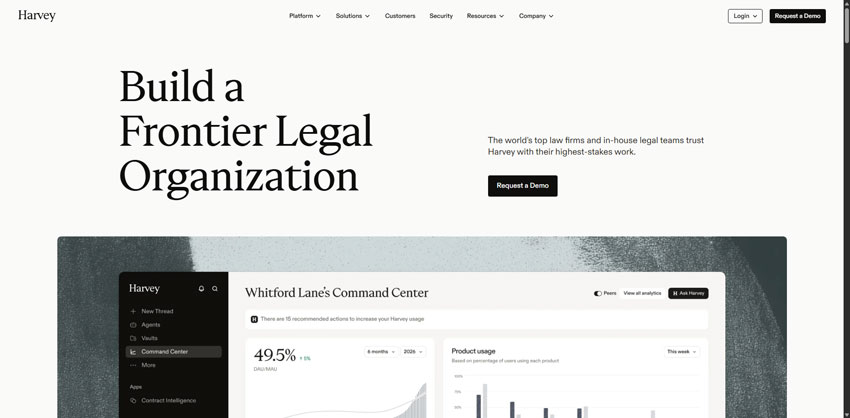
Harvey is an AI platform focused on professional services, with legal work being one of its major areas of application. It is designed to help lawyers with activities such as legal research, document analysis, drafting and complex matter workflows.
For law firms, a major attraction of specialized platforms such as Harvey is the ability to build AI-assisted workflows around real legal work rather than using a general chatbot for every task. Firms can use AI to support research, review documents and prepare work products while attorneys remain responsible for the final result.
Harvey’s growing adoption also demonstrates how quickly legal AI is becoming part of professional workflows. However, recent litigation has highlighted the risks of relying on AI-generated legal work without adequate verification. A federal judge in New York recently warned about citation errors in AI-assisted court filings and stressed the importance of careful review.
The lesson for law firms is simple: powerful legal AI still requires qualified human oversight.
Website Link – https://www.harvey.ai/
Why Law Firms Have to Use AI Tools in 2026
Lawyers spend significant amounts of time researching authorities, reviewing documents, drafting correspondence and preparing case materials. AI can reduce the amount of manual work involved in these activities, allowing lawyers to dedicate more time to strategy, negotiation, client communication and other tasks that depend heavily on professional experience.
AI adoption is no longer limited to technology-focused firms. Clio’s 2026 research reports that 79% of legal professionals use AI in some capacity, while Thomson Reuters reports that 41% of law firms surveyed are using generative AI in 2026.
The benefits can be especially meaningful when firms use AI for high-volume work. Reviewing contracts, organizing discovery materials, summarizing case files and preparing first drafts can consume hours that could otherwise be spent on higher-value legal work.
However, legal AI also introduces significant risks. Accuracy, confidentiality, bias, intellectual property and liability all need to be considered.
Recent regulatory developments make this even more important. California enacted legislation in 2026 establishing specific guardrails for lawyers using AI, including requirements around verification of court filings and protection of confidential information.
Law firms should therefore adopt AI with written policies, appropriate security controls and mandatory human verification rather than treating AI output as automatically reliable.
Conclusion
AI tools for lawyers in 2026 can transform how law firms handle research, document review, drafting, case preparation and administrative work. Platforms such as CoCounsel Legal, Lexis+ with Protégé, Clio Work, Vincent and Harvey show how legal AI is moving toward specialized workflows grounded in legal information and firm data.
The most important consideration is not simply how quickly an AI tool produces an answer. Lawyers need to know where that answer came from, whether the underlying authority is reliable and whether confidential client information is being handled appropriately.
AI should make lawyers more efficient without transferring professional responsibility from the lawyer to the technology.
Law firms that combine specialized AI tools with strong review processes, secure data practices and experienced legal professionals can benefit from automation while reducing unnecessary risk. The future of legal AI is therefore less about replacing lawyers and more about giving them better tools for handling increasingly complex workloads.
FAQ
Q1. What are AI tools for lawyers?
AI tools for lawyers are software solutions that assist with legal research, document analysis, drafting, case preparation, contract review, matter management and administrative tasks.
Q2. What is the best AI tool for law firms?
There is no single best tool for every firm. CoCounsel Legal and Lexis+ with Protégé are strong options for research and legal work, while Clio Work and Vincent can be useful for firms looking for matter-aware AI and integrated workflows.
Q3. Can AI replace lawyers?
No. AI can automate and assist with many legal tasks, but lawyers remain responsible for professional judgment, client advice, accuracy, confidentiality and final work product.
Q4. Is it safe for lawyers to use AI?
AI can be used responsibly when firms select appropriate legal-specific tools, review vendor security and data policies, establish internal AI rules and verify important outputs. Confidential client information should never be entered into an AI system without understanding how that information is handled.
Q5. Can AI make mistakes in legal research?
Yes. AI can produce inaccurate statements or incorrect citations. Every important AI-generated legal claim and citation should be checked against authoritative primary sources before being relied upon or submitted to a court.