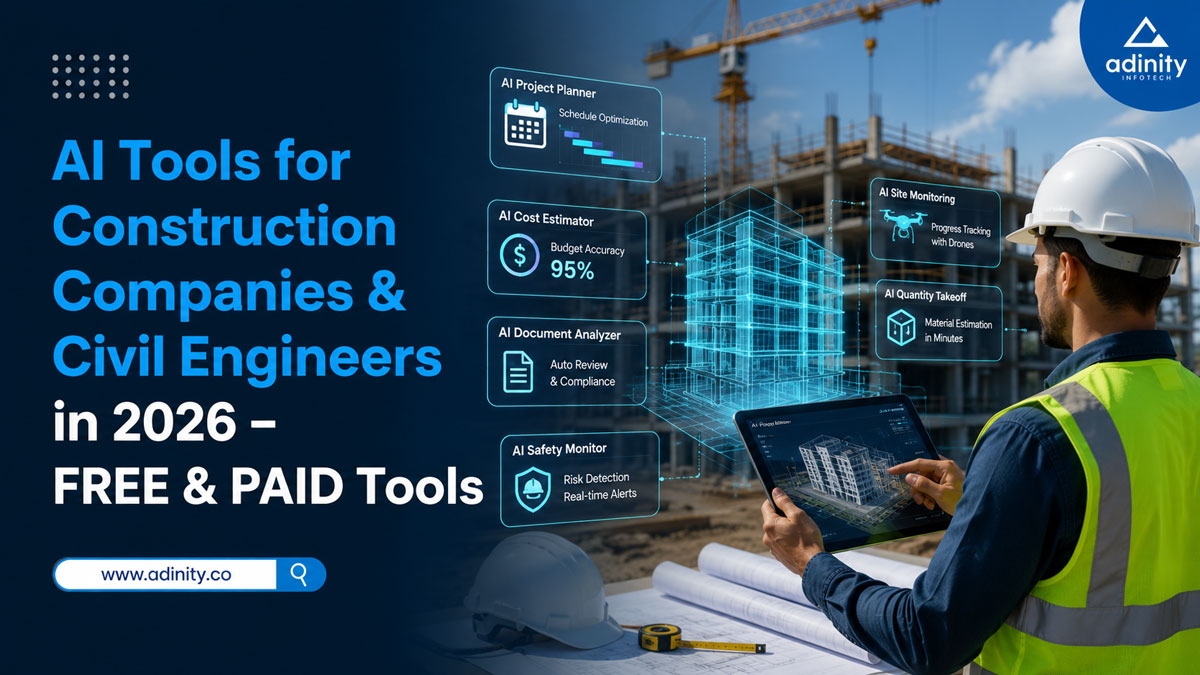
When talking about AI tools for construction companies and civil engineers in 2026, this is really a new era of construction and engineering with faster project planning, reduced administrative workload, better documentation and improved decision-making. These tools include AI for construction project management, estimating, BIM and design, site monitoring, scheduling, documentation, safety and engineering workflows, helping construction professionals complete some of their everyday work more efficiently.
The growing complexity of construction projects, increasing documentation requirements and the need to control costs and timelines across India and the USA demand smarter solutions for construction companies and civil engineering professionals. AI-powered tools can streamline repetitive tasks, organize project information and provide useful insights, allowing engineers, contractors, project managers and site teams to concentrate on delivering projects successfully.
Advantages of AI Tools for Construction Companies & Civil Engineers
- Faster project planning and documentation
- Reduced administrative workload
- Improved construction progress tracking
- Faster quantity takeoffs and estimating
- Better project coordination
- Improved scheduling and risk identification
- More efficient engineering workflows
Below are the best AI tools for construction companies and civil engineers in 2026 & beyond –
1. Procore AI
Procore is a construction management platform that now includes AI capabilities designed specifically for construction workflows. Procore AI can help teams search and analyze project information, work with drawings, RFIs, submittals and other project documents, and assist with repetitive workflows. Procore says its AI can also stage proposed changes for human review before they are implemented.
For construction companies managing multiple projects, this can help reduce the time spent searching through documents and handling repetitive administrative work. Project managers, engineers, contractors and other construction professionals can use AI-assisted workflows to access relevant project information more efficiently.
Website Link – https://www.procore.com/ai

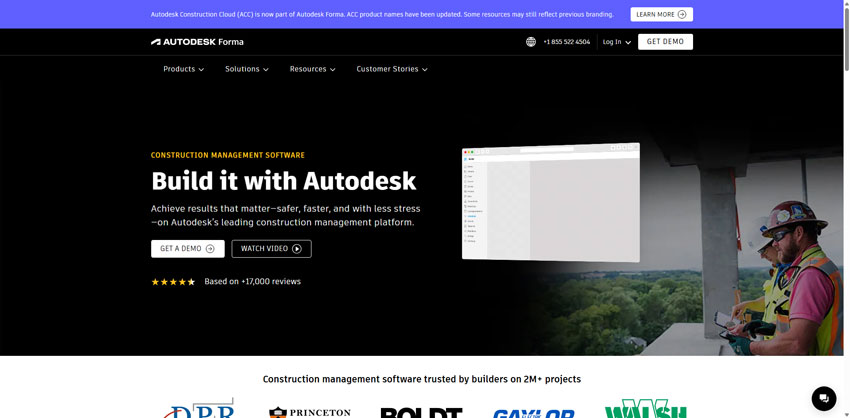
2. Autodesk Construction Cloud
Autodesk Construction Cloud provides construction management and collaboration tools that connect project teams, documents, BIM information and field workflows. Its ecosystem is particularly useful for construction companies and civil engineering teams working with digital drawings, models and project documentation.
The platform can help teams coordinate design and construction information, manage project documents and connect office and field teams. Autodesk also supports integrations with AI-powered construction technologies such as OpenSpace for visual documentation and progress tracking.
This makes Autodesk Construction Cloud useful for companies looking to combine BIM, project management and digital construction workflows in one connected environment.
Website Link – https://construction.autodesk.com/
3. OpenSpace
OpenSpace is an AI-powered visual intelligence platform for construction that helps teams capture and document jobsites using 360-degree imagery and computer vision. Construction teams can create visual records of projects and track what is happening on site without relying entirely on manual documentation.
OpenSpace has expanded its platform with OpenSpace Field, which uses spatial AI to help teams create and manage punch-list items, observations and issues directly from field information. It also integrates with platforms such as Procore and Autodesk Construction Cloud.
For civil engineers, contractors and project managers, visual documentation can make it easier to monitor construction progress, identify issues and maintain a reliable record of site conditions.
Website Link – https://www.openspace.ai/

4. Buildots
Buildots is an AI-powered construction progress tracking platform that uses computer vision and project data to help construction teams monitor actual progress against planned work.
The technology can help project teams identify differences between planned and actual construction progress and provide greater visibility into what is happening on a jobsite. This can be useful for project managers and contractors who need to identify potential delays early and maintain better control over project schedules. Current 2026 construction-AI comparisons continue to identify Buildots as a leading tool for AI-based progress monitoring.
By combining site information with project schedules and models, AI-powered progress tracking can help construction teams make more informed decisions during project execution.
Website Link – https://buildots.com/
5. Togal.AI
Togal.AI is an AI-powered construction estimating and takeoff platform designed to analyze construction drawings and help users identify and measure elements within plans.
For estimators, contractors and civil engineering professionals, automated takeoff technology can reduce the amount of manual work required when reviewing drawings and preparing quantities. AI can help identify relevant drawing elements more quickly, while construction professionals remain responsible for reviewing quantities and ensuring that estimates are appropriate for the project.
AI-powered takeoff and estimating tools are becoming an important category within construction technology because estimating can involve large volumes of drawings, measurements and project information.
Website Link – https://www.togal.ai/

Why Construction Companies & Civil Engineers Have to Use AI Tools in 2026
Construction companies and civil engineering professionals spend a significant amount of time dealing with drawings, documentation, project updates, estimates, schedules, RFIs, coordination and other administrative tasks. Meanwhile, AI tools are increasingly being developed specifically for construction workflows, from project management and document analysis to site monitoring, estimating and scheduling.
AI can help construction professionals automate repetitive work, find project information faster and gain better visibility into project progress. However, AI should support engineers, contractors and project managers rather than replace professional judgment. Final engineering decisions, structural designs, safety decisions and construction approvals should remain under the responsibility of appropriately qualified professionals.
Conclusion
AI tools for construction companies and civil engineers in 2026 are helping transform how construction projects are planned, monitored and managed. From Procore AI and Autodesk Construction Cloud to OpenSpace, Buildots and Togal.AI, these technologies can assist with project management, documentation, progress tracking, estimating and other important construction workflows.
Construction companies that adopt AI thoughtfully can reduce repetitive administrative work, improve project visibility and help their teams make faster, better-informed decisions. As AI technology continues to develop, the most effective approach will be to combine AI capabilities with the experience and professional judgment of engineers, contractors and construction teams.
FAQ
Q1. What are AI tools for construction companies and civil engineers?
AI tools for construction companies and civil engineers are software solutions that use artificial intelligence to assist with tasks such as project management, estimating, drawing analysis, construction progress tracking, documentation, scheduling and engineering workflows.
Q2. What is the best AI tool for construction companies?
The best tool depends on the company’s requirements. Procore AI can support construction project management and document workflows, OpenSpace can help with visual site documentation, Buildots focuses on progress tracking, and Togal.AI can assist with construction takeoffs and estimating.
Q3. Can AI help civil engineers with construction projects?
Yes. AI can assist civil engineers with tasks such as analyzing project information, organizing documentation, monitoring progress, reviewing drawings and supporting certain planning workflows. Engineers should always review AI-generated outputs and remain responsible for professional engineering decisions.
Q4. Can AI reduce construction project delays?
AI can help identify potential schedule issues, compare planned and actual progress, and provide project teams with information that may help them respond to problems earlier. However, AI cannot guarantee that a construction project will be completed on time.
Q5. Will AI replace civil engineers and construction workers?
AI is primarily being used to assist construction professionals with information processing, documentation, planning and repetitive tasks. Civil engineers and construction workers still provide essential professional judgment, physical skills, project experience, safety oversight and decision-making that cannot simply be replaced by AI.