

AI tools for keyword research free in 2026 can help bloggers, digital marketers, website owners, and small businesses discover relevant search terms without investing in expensive SEO software. From finding long-tail keywords to understanding search intent and identifying trending topics, these tools make keyword research easier, even if you are just starting with SEO.
However, not every free tool provides the same information. Some show keyword suggestions and estimated search volumes, while others help you understand what people are searching for or identify opportunities from your existing website traffic. Combining a few reliable tools can help you develop a practical keyword strategy without paying for multiple subscriptions.
Advantages of AI Tools for Keyword Research
Keyword research is the process of identifying the words and phrases people use when searching for information, products, or services online. Modern keyword research tools can speed up this process by organizing suggestions, identifying related questions, and providing useful SEO data.
Here are some important advantages of using free keyword research tools:
- Discover new keyword ideas: Find related search terms, long-tail keywords, and specific phrases relevant to your business.
- Understand search intent: Identify whether people want information, product comparisons, services, or a solution to a particular problem.
- Find content opportunities: Discover questions and related topics that can become blog posts, landing pages, or social media content.
- Research keywords on a budget: Start developing an SEO strategy without immediately purchasing premium subscriptions.
- Understand search demand: Use available search volume estimates and trend data to evaluate potential topics.
- Improve content planning: Organize keywords into topic clusters and build a more consistent publishing schedule.
- Support AI search visibility: Develop useful, clearly structured content that answers questions people may ask traditional search engines and AI-powered search platforms.
Quick Comparison of Free Keyword Research Tools
| Tool | Best For | Free Access | Main Benefit |
|---|---|---|---|
| Google Keyword Planner | Search volume and advertising research | Free with a Google Ads account; setup requirements apply | Keyword ideas and search estimates |
| Ahrefs Free Keyword Generator | Finding related keywords | Free generator with limited results | Keyword suggestions and SEO metrics |
| Semrush Free Keyword Tool | Quick keyword analysis | Free access with limitations | Volume, difficulty, and search intent |
| Google Trends | Trending and seasonal topics | Free | Compare search interest over time |
| AnswerThePublic | Questions and content ideas | Limited free searches | Discover question-based keywords |
Free access and usage limits can change, so check each provider’s website before planning a large research project.
Below Are the Best AI Tools for Keyword Research Free in 2026 & Beyond
1. Google Keyword Planner
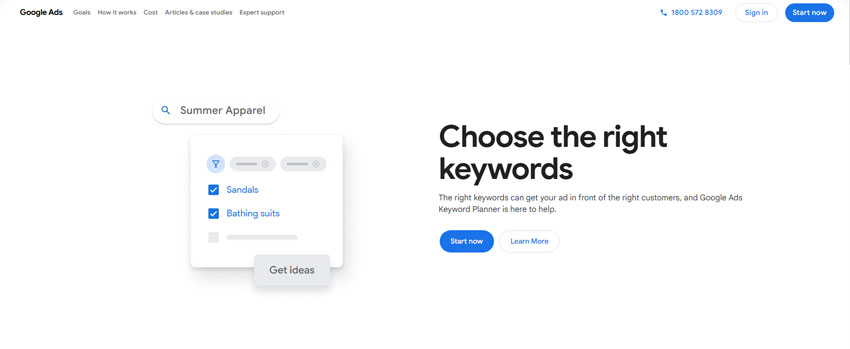
Google Keyword Planner is a useful starting point for keyword research, particularly for businesses that want to understand search demand and plan Google Ads campaigns. Although it is not exclusively an AI tool, it provides keyword discovery and search estimates that can support an SEO content strategy.
You can enter a seed keyword, product, service, or website to discover related search terms. The tool provides estimated monthly search volumes, advertising competition, and bid estimates. These insights can help you compare topics and identify phrases that may be relevant to your audience.
For example, a digital marketing agency could research terms such as “SEO services for small businesses,” “website development company,” and “digital marketing agency near me.” Location and language settings can help make the research more relevant to a particular market.
One limitation is that advertising competition does not directly measure organic SEO difficulty. Search volume estimates may also be presented in ranges depending on account conditions. Google requires users to complete account setup, including billing information, to access basic keyword ideas.
Best for: Beginners, advertisers, small businesses, and marketers researching keywords for Google-focused campaigns.
Website Link – https://ads.google.com/home/tools/keyword-planner/
2. Ahrefs Free Keyword Generator
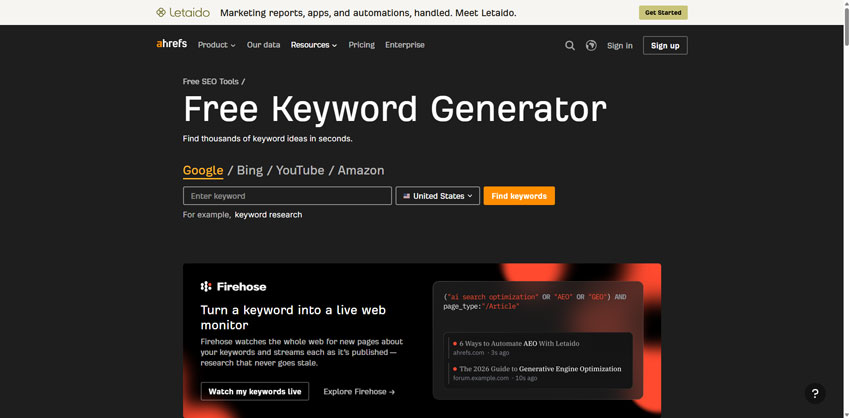
Ahrefs Free Keyword Generator helps users discover keyword ideas without immediately purchasing a paid SEO subscription. It is particularly useful when you need related search terms, question-based phrases, and an initial understanding of the opportunities around a topic.
Enter a primary keyword and select a supported search engine and country. The tool can return related keyword ideas alongside available SEO metrics, helping you explore variations that might be worth targeting.
For example, someone researching “email marketing” could investigate phrases such as “email marketing for beginners,” “free email marketing tools,” and “how to build an email list.” These variations can support separate blog posts or sections within a comprehensive guide.
The free generator is useful for initial research, but it does not replace a complete competitor analysis. Results and available metrics are limited compared with the full Ahrefs platform. You should validate promising terms and examine the pages currently ranking before choosing your target keywords.
Best for: Bloggers, freelance SEO professionals, content marketers, and website owners who want keyword ideas without paying upfront.
Website Link – https://ahrefs.com/keyword-generator
3. Semrush Free Keyword Tool
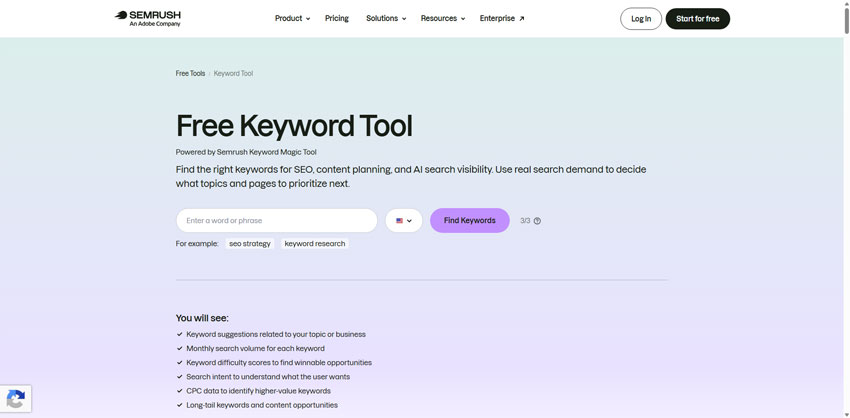
Semrush offers a free keyword research tool that can help you investigate search terms, related keywords, and potential content opportunities. It is worth considering when you want more context than a basic keyword suggestion list provides.
Depending on the data available for your search, you can explore estimated search volume, keyword difficulty, search intent, cost-per-click information, and related phrases. These metrics can help you assess whether a keyword matches your business objectives and the content you plan to publish.
Suppose you run an online store selling skincare products. Instead of targeting only “skincare products,” you could investigate more specific terms such as “skincare routine for oily skin” or “best moisturizer for sensitive skin.” Specific phrases can help you create content that addresses distinct customer needs.
The free tool has limitations, and access to broader keyword databases and advanced analysis may require a paid plan. Treat difficulty scores and volume figures as estimates rather than guarantees of ranking potential.
Best for: SEO beginners, content strategists, and digital marketing agencies conducting preliminary keyword research.
Website Link – https://www.semrush.com/analytics/keywordmagic/
4. Google Trends
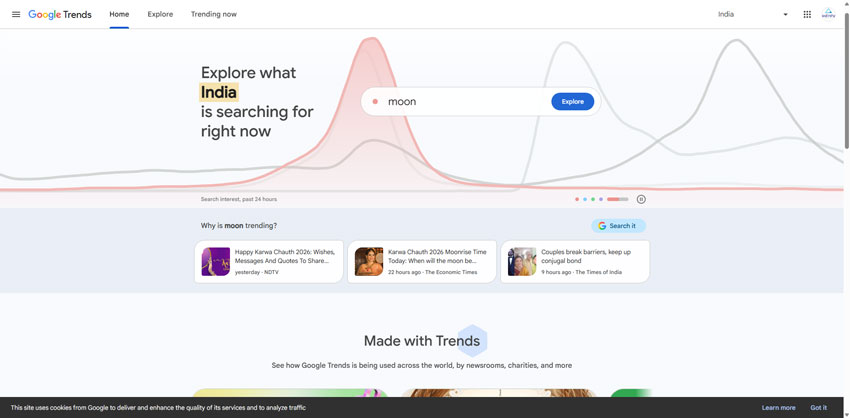
Google Trends is a free research tool that shows how interest in search topics changes over time. Unlike conventional keyword research platforms, it focuses on relative search interest rather than providing a standard monthly search volume figure for every keyword.
You can compare multiple terms, examine seasonal patterns, and explore interest by geographic region. These features are useful for deciding when to publish content and identifying subjects that are gaining or losing attention.
For example, an ecommerce business could compare interest in “winter skincare” and “summer skincare” to understand seasonal differences. A digital marketing blogger could compare related topics before deciding which one deserves a new article.
Google Trends can also help distinguish an established topic from a short-lived trend. However, a rising trend does not automatically mean a keyword has high search volume or low competition. Combine trend data with another keyword research tool before making major content decisions.
Best for: Bloggers, ecommerce businesses, publishers, and marketers researching seasonal or emerging topics.
Website Link – https://trends.google.com/trends/
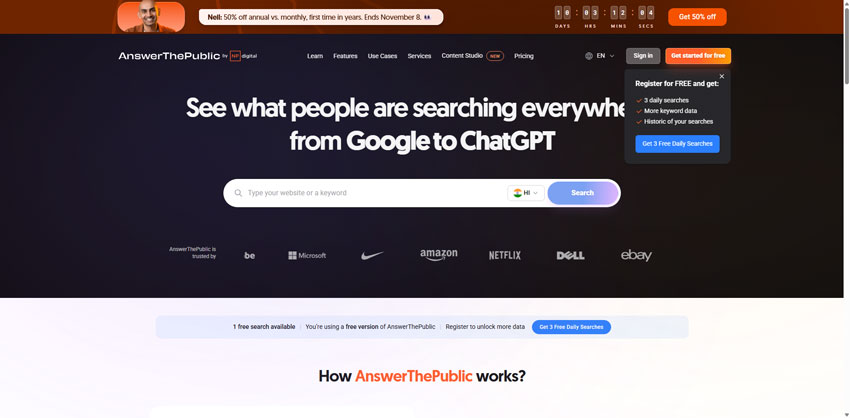
5. AnswerThePublic
AnswerThePublic helps content creators discover questions and phrases people associate with a particular topic. It is especially useful when you want to move beyond broad keywords and understand the specific concerns your audience may have.
Enter a topic to explore question-based searches, comparisons, and related phrases. These suggestions can help you plan blog articles, FAQ sections, educational videos, and supporting content for service pages.
For example, researching “keyword research” may inspire content around questions such as “How does keyword research work?”, “Which keyword research tool is free?” and “How do beginners find long-tail keywords?”
This approach can support SEO and answer-focused content strategies because it encourages you to address clear user questions. Nevertheless, suggested phrases should be checked for relevance, search demand, and competition before you prioritize them.
AnswerThePublic offers limited free usage, so it may be more suitable for occasional research than large-scale keyword discovery. Check its current plan details before relying on a particular search allowance.
Best for: Bloggers, content marketers, agencies, and businesses creating educational content.
Website Link – https://answerthepublic.com/
Why Businesses Have to Use Free Keyword Research Tools in 2026
Search visibility depends on understanding what your audience needs and creating content that satisfies those needs. Keyword research helps you make informed decisions instead of publishing articles based only on assumptions.
Free tools are particularly valuable for startups, small businesses, freelancers, and website owners working with limited marketing budgets. You can begin with basic research and invest in paid software only when your workload or reporting requirements justify it.
The goal is not to find the highest-volume keyword; it is to find relevant keywords that match user intent and offer a realistic opportunity to attract the right audience.
How to Use Keyword Research for SEO, AEO, AIO, and GEO
Keyword research in 2026 can support more than traditional search engine rankings. It can also help you create useful content for answer engines and AI-powered search experiences.
- SEO (Search Engine Optimization): Choose relevant keywords, examine search results, and create useful pages that address the topic thoroughly.
- AEO (Answer Engine Optimization): Identify common questions and answer them directly using clear headings and concise explanations.
- AIO (AI Optimization): Organize accurate, helpful information so AI-powered systems can better interpret the subject and its context.
- GEO (Generative Engine Optimization): Publish trustworthy, well-supported content that can be understood and potentially referenced in generative search experiences.
No keyword tool can guarantee visibility in Google rankings or AI-generated answers. Focus on satisfying user intent, demonstrating expertise, and keeping your content accurate and useful.
FAQ
Q1. Which is the best free keyword research tool in 2026?
Google Keyword Planner is a strong starting point for keyword discovery and search estimates. Ahrefs is useful for related keyword ideas, while Google Trends helps identify seasonal interest. The best choice depends on your research requirements.
Q2. Can I do keyword research without paying?
Yes. You can combine free tools such as Google Keyword Planner, Google Trends, Ahrefs Free Keyword Generator, and Semrush’s free keyword tool. Some require account setup or impose usage limits.
Q3. Are AI keyword research tools accurate?
These tools can provide useful suggestions and estimates, but their data is not always exact. Validate important keywords using multiple sources and examine actual search results before making content decisions.
Q4. How do I find low-competition keywords for my website?
Start with specific long-tail keywords, investigate their search intent, and review the websites currently ranking for them. Choose relevant topics where you can provide more useful information than competing pages. Remember that keyword difficulty scores are estimates, not guarantees.
Q5. Can free keyword research tools help with AI search optimization?
Yes. They can help you identify relevant questions, related topics, and audience needs. Use these insights to create accurate, clearly structured content that directly answers questions. However, no tool guarantees inclusion in AI-generated search results.
Conclusion
Finding effective keyword research tools does not have to be expensive. Google Keyword Planner, Ahrefs Free Keyword Generator, Semrush Free Keyword Tool, Google Trends, and AnswerThePublic each offer different ways to discover search terms and develop content ideas.
Start with one primary tool, then use another to validate promising keywords. Review search intent, study competing pages, and prioritize topics that are relevant to your audience and business goals.
A practical free keyword research process can help you build a stronger content strategy without purchasing an expensive SEO subscription from day one.